Austro-Hungarian Project I Battlecruiser Designs
The KuK Kriegsmarine produced a number of capital ship designs starting from around the time of the Battle of Jutland to late 1917, early 1918 featuring mostly battlecruiser designs but a few battleships as well. Not much is known about the history of these designs apart from that they are prepared for the post war fleet, showing that the Austro-Hungarian Empire wished to end the war soon.
None the less, these project feature a good amount of ingenuity as well as traditional elements. Some of you might think these designs strike resemblance to the French warships of the same period like the grouped casemated guns and clear firearcs showing that either the Austro-Hungarians taken the same way of ideas and thinking as the French or simply copied them.
Typical to the Germanic nations these design does not feature the all or nothing armour scheme, instead the armour belt covers almost 100% of the waterline length with the main belt thickness of 225mm (9") and the ends having 100mm (4") which is quite comparable with the armours of the Royal Navy Battlecruisers.
Armament consisted of 35cm Cannons the same to be used on the Ersatz Monarch class and which was chosen over the 34.5cm because there was a standard shell in development which could be used both in the Austro-Hungarian Navy and the Imperial German Navy.
In 1915 the naval staff of the KuK Kriegsmarine have been impressed by the escape of the German Battlecruiser SMS Goeben from the British forces as well as the effectiveness of the Royal Navy battlecruisers HMS Invincible and HMS Inflexible in the battle of Falklands of 1914 December and asked MTK (Marinetechnische Komitee - Naval Technical Committee), Pola to produce designs (at least these were the ones that survived) for the post war fleet and by late 1915 - early 1916, the first design, Project I was born.
It was a battlecruiser derived from the Ersatz Monarch / Improved Tegetthoff class battleships of 1912 and similarly featured 35cm cannons in with various layouts with 15cm secondary and 9cm tertiary armament to fight off enemy cruisers and destroyers.
The design(s) had the following characteristics:
Dimensions: 220 (wl) x 29 x 8,65m
Displacement: 30.000tons (standard), 34.000tons (full load)
Armour: 40mm Deck, 225mm Belt
Engines: 100.000shp Danubius Steam Turbines, 4 shafts
Speed: 56km/h (30knots)
Range: 14.800km at 28km/h (8.000nm at 15knots)
Armaments:
4x2 35cm/45 (3x3 on variant a) Skoda K14 Cannons
18x1 15cm/50 Skoda K10 Guns
12x1 9cm/45 (88mm) Skoda K12 Guns
6x1 9cm/45 (88mm) Skoda K16 AA Guns (8x1 on variant b,c 4x1 on variant f)
6x1 53cm Underwater Torpedo tubes
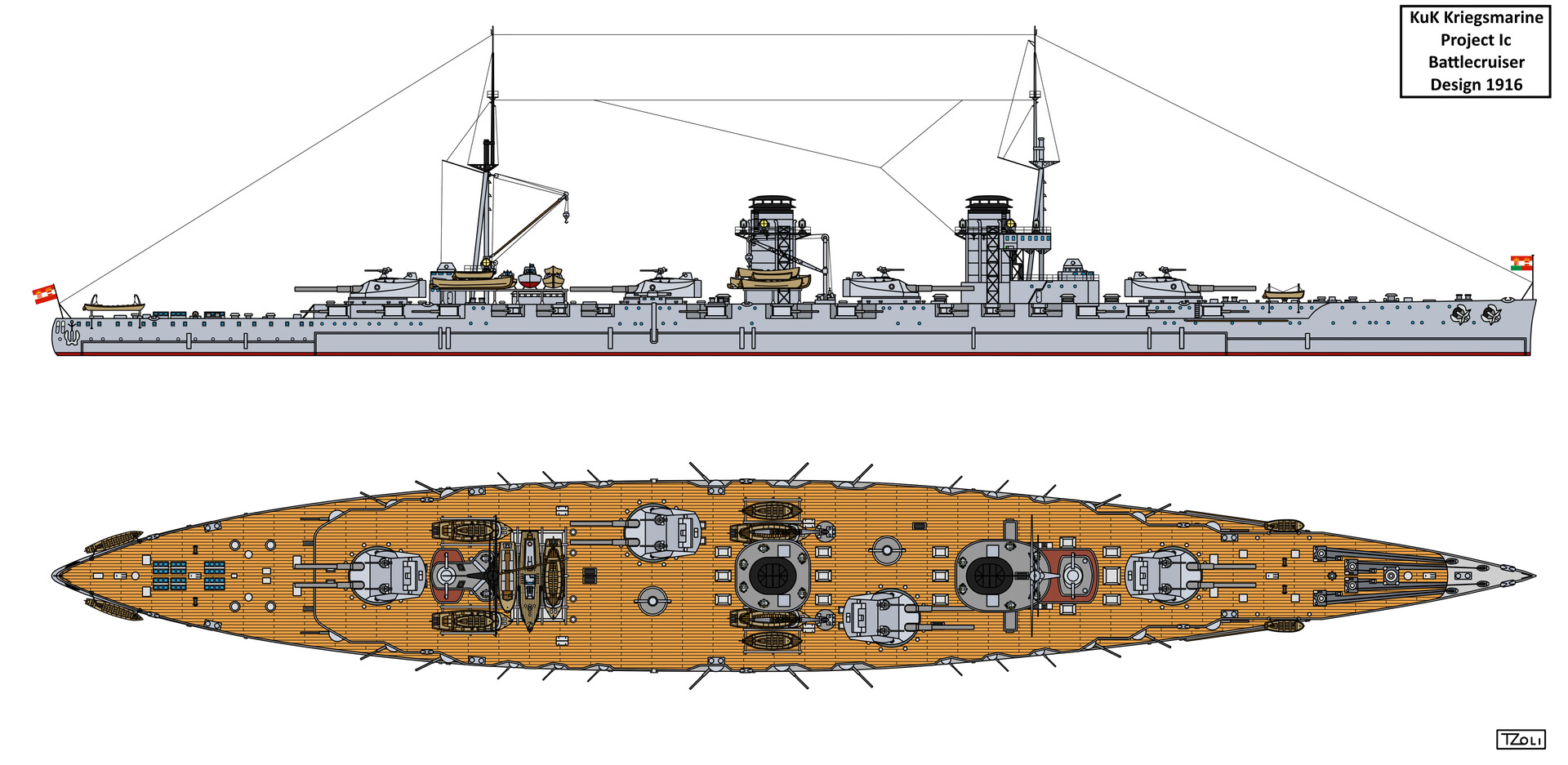
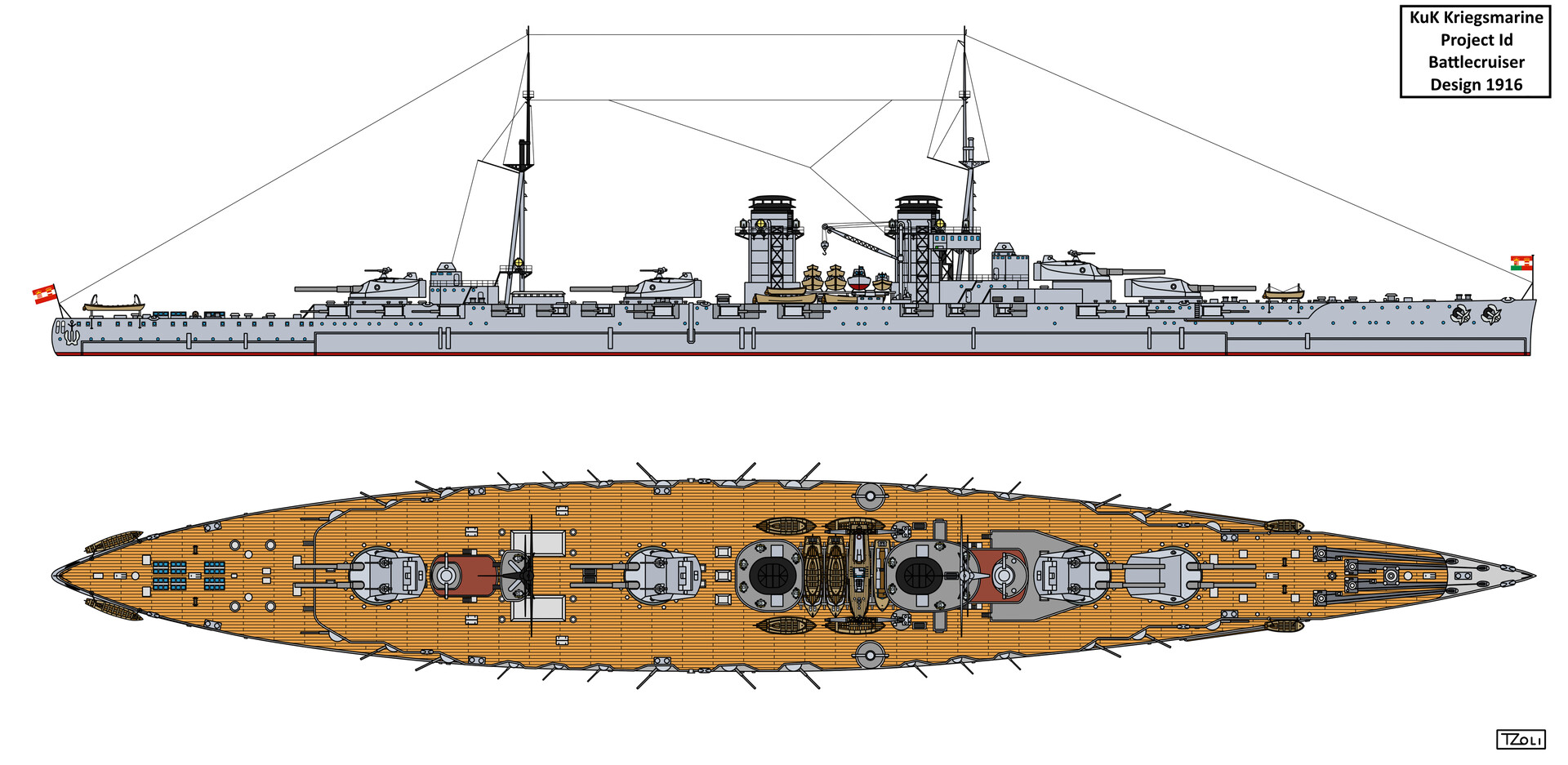
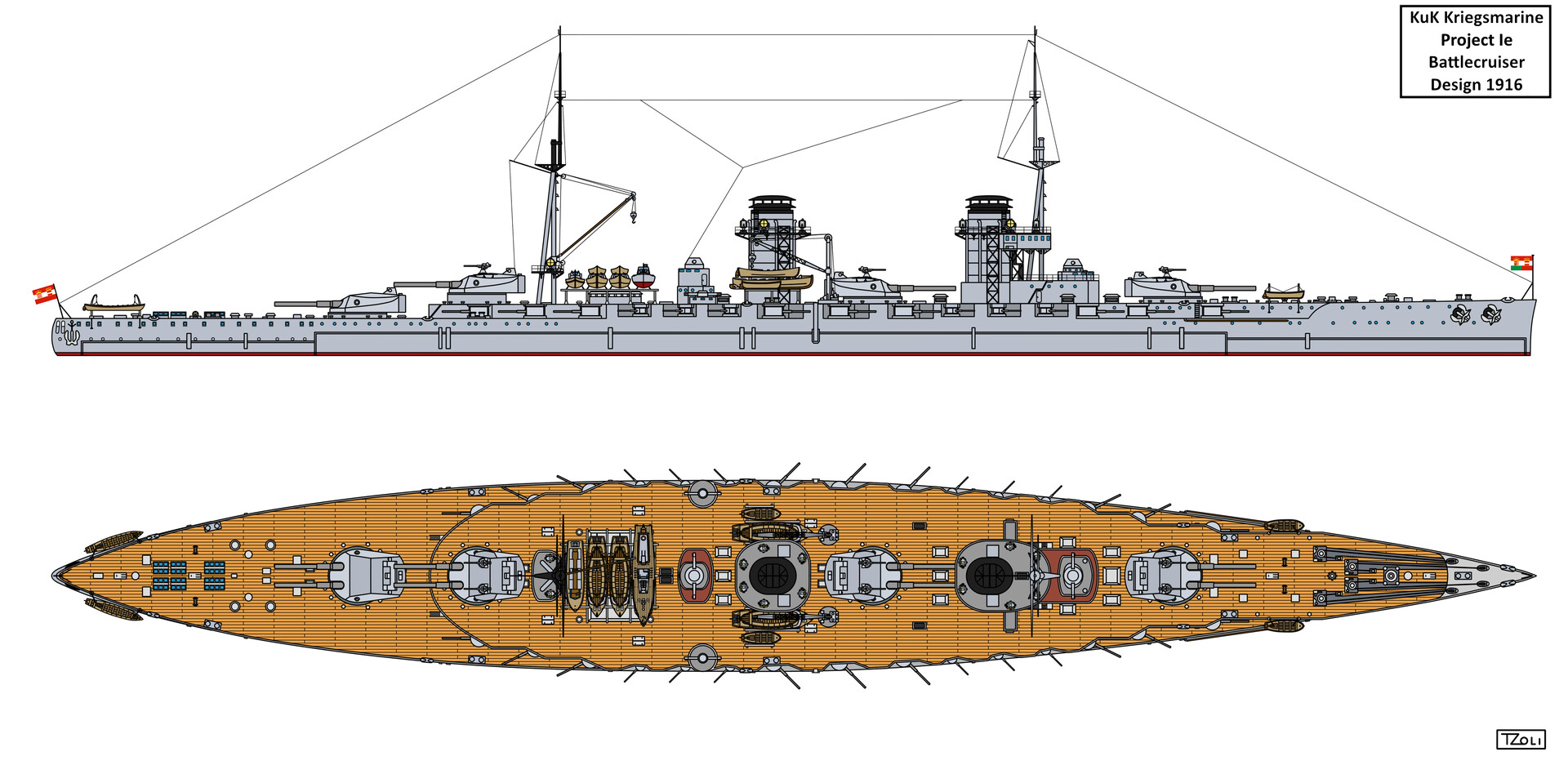
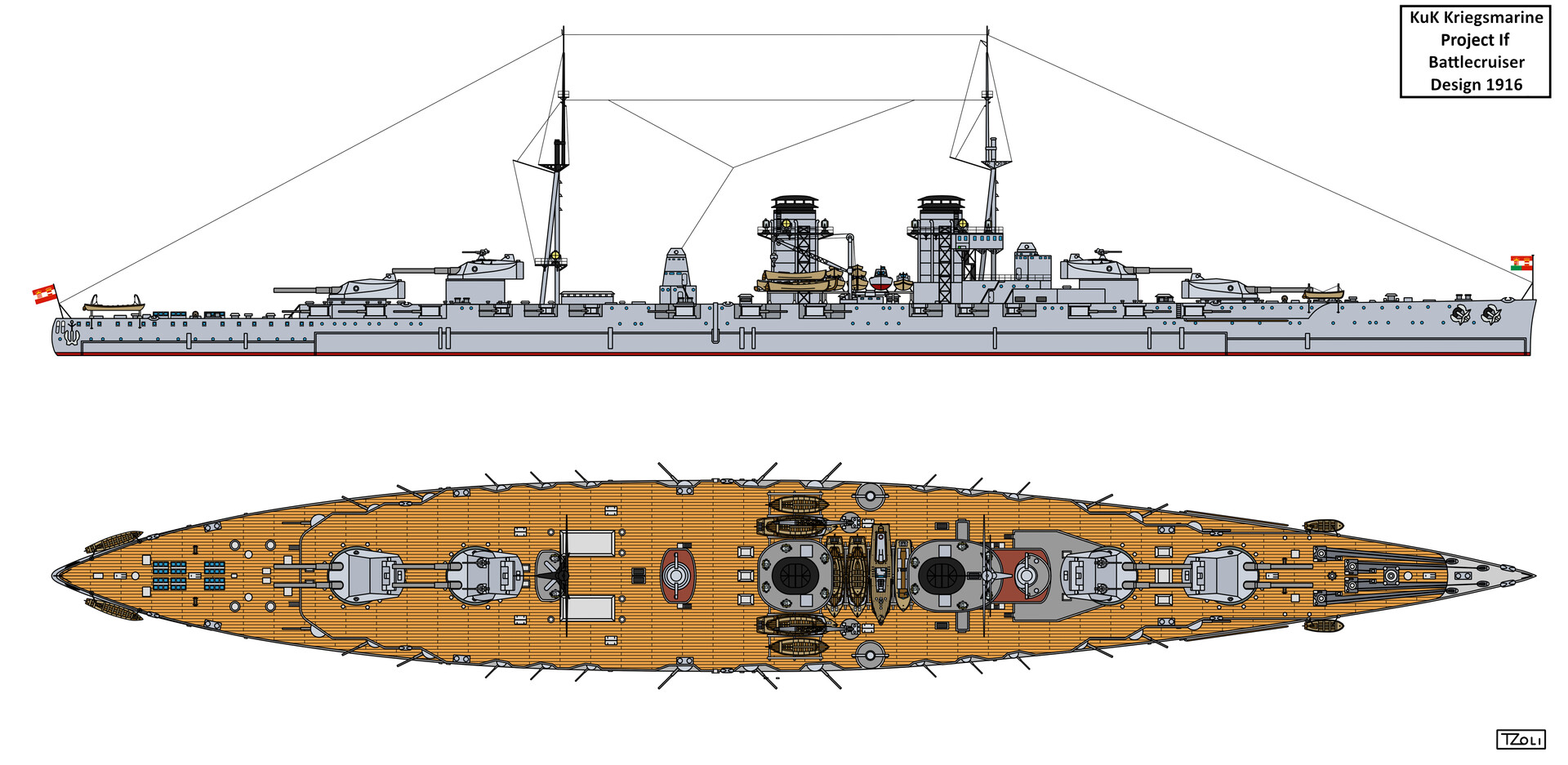
On Variant A 3 triple turrets were chosen all on the same level on the centreline and this was the true battlecruiser equivalent of the Ersatz Monarch class, though this layout seem not to be favoured as all consequent proposals featured twin turrets.
Variant B and C featured 4 twin turrets with C 2 of the middle turret offset to the sides ad echelon arrangement providing ahead and abaft fire which was not possible in the previous designs.
Variant D,E and F are again basically the same, differing only in placement of the a superfring turret in either forward, aft or both.
The original drawings can be found here:
http://www.viribusunitis.ca/images/predesign1a-large.jpg
http://www.viribusunitis.ca/images/predesign1bc-large.jpg
http://www.viribusunitis.ca/images/predesign1d-large.jpg
http://www.viribusunitis.ca/images/predesign1e-large.jpg
http://www.viribusunitis.ca/images/predesign1f-large.jpg
http://www.viribusunitis.ca/predesigns.html


Or here together with a small history on them:
https://stefsap.wordpress.com/2017/12/20/austria-hungarys-naval-building-projects-1914-1918-cruisers-2/
And finally based on the naming conventions of the German and Austro-Hungarian navies, the name of the class most likely be Ersatz Kaiser Karl or Ersatz Maria Theresia the two oldest armoured cruisers of the KuK navy.